
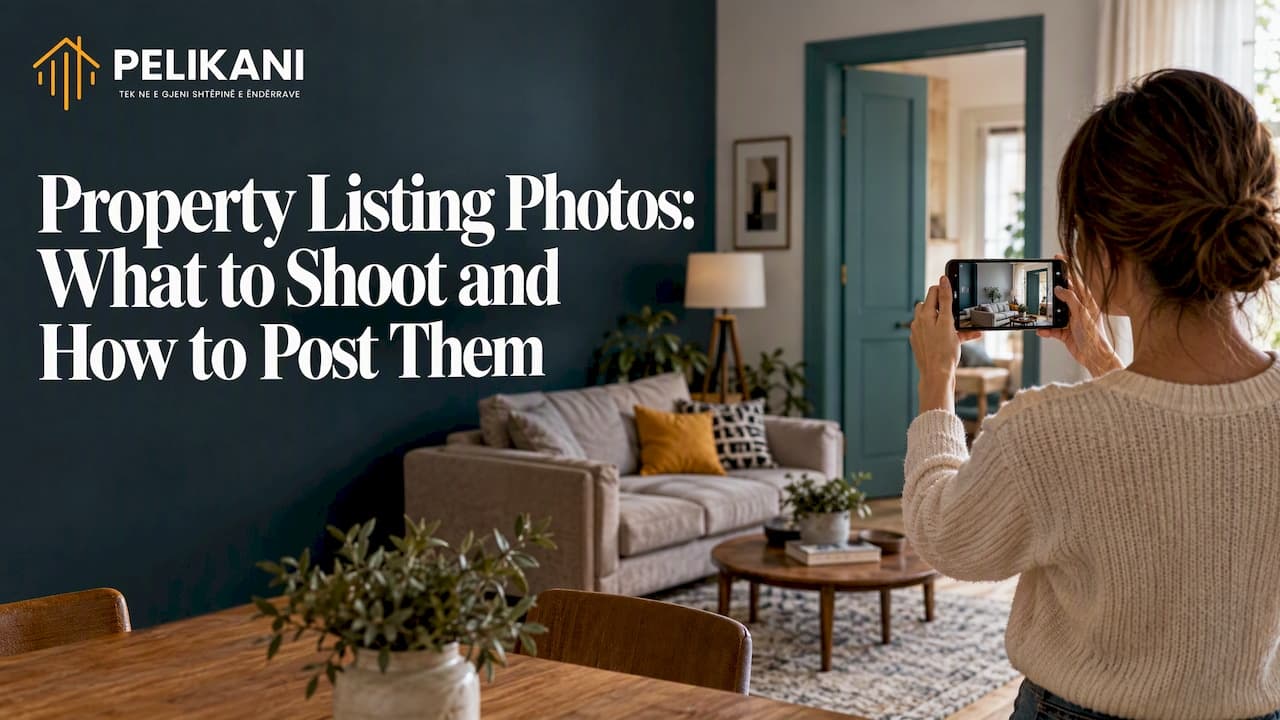
Good property listing photos do one job: they let a stranger decide, from a phone screen, whether your home is worth a viewing. To do that, shoot every room in daylight, keep the frame straight and uncluttered, post sharp horizontal images in a sensible order, and edit only to show the place as it really is. You don't need a professional kit to do this. You need a plan, an hour of tidying and a little patience.
This guide is written for owners, landlords and agents who post on Kosovo and Albania-facing portals. It covers what to photograph, how to light it, which file sizes to use, how to order the gallery and which mistakes quietly cost you inquiries.
TL;DR
- Photograph every room, including bathrooms, toilets and hallways, from more than one angle, and show the building too.
- Use soft natural light on a clear day, shoot straight ahead and keep the camera horizontal.
- Upload sharp landscape images of at least 1200 × 800 pixels in JPEG, and keep each file under about 10 MB.
- Edit only brightness, contrast, crop and straightening. The photos must show what the viewer will actually find.
- Lead with your strongest, most representative image, then walk the buyer through the home in the order they would see it.
Table of Contents
- Why photos decide whether people call
- Prepare the property before you pick up the camera
- Light: the cheapest upgrade you have
- Framing: how to make rooms look like what they are
- Which photos to include
- Ordering the gallery
- Size, resolution and format
- Editing without misleading
- Mistakes that quietly cost inquiries
- Photos in the context of the Kosovo and Albania market
- Our perspective
- Put your photos to work on Pelikani
- FAQ
- Sources
Why photos decide whether people call
A buyer or renter cannot touch the property from a screen. Housing research describes photos of an apartment's interior, its exterior and its building as indirect visual signals of quality in online listings. In other words, the pictures stand in for a visit. They work alongside the written specifications and the viewing, not instead of them, but they decide who bothers to ask for the viewing.
The evidence from rentals points the same way. A 2024 RentCafe survey found that 73% of renters prioritized interior apartment photos; respondents came from the US, Canada and other countries, so treat it as a signal about behavior, not a figure for Albania. For Albania specifically, Flatio's help page explains that people often decide whether to consider a place based on its photos, and that dark, blurred or low-resolution images, or images that fail to show the property properly, put them off.
The practical conclusion is simple. Your listing competes with dozens of others on the same results page. The reader scrolls fast, and the first few photos are often all they see before deciding to continue or leave.
Prepare the property before you pick up the camera
Most of the difference between a weak gallery and a strong one is made before the first shot.
- Clear surfaces. Remove laundry, bottles, cables, magnets on the fridge, toiletries by the sink and anything personal. Airbnb's photo guidance recommends clean, decluttered spaces, and the same logic applies to a flat for sale.
- Open the curtains and turn lights on. Natural light first, then switch on lamps to fill dark corners so the room doesn't look like a cave.
- Make the beds, fold the towels, close the toilet lid. It sounds trivial. A bathroom shot with a clutter of bottles reads as neglect.
- Fix the small things you can. A hanging cable, a cracked socket cover or a stained grout line is visible at full resolution and signals that the owner doesn't care.
- Clean the windows. Smudged glass flattens the light and shows up as haze.
- Check the weather. Flatio advises choosing a time when the weather is nice and the property looks its best. A grey day makes even a bright flat look tired.
If the property is furnished, show the furniture as it really is and as it will be handed over. If it is empty, a few clean, well-framed shots of empty rooms are better than staged images that suggest a different home.
Light: the cheapest upgrade you have
Soft daylight beats any flash. Airbnb recommends soft natural light and straight-ahead framing, and that is a good rule for any listing. A few practical habits:
- Shoot when the room is brightest, but avoid harsh direct sun. Rooms facing south can look blown out at midday. Check each room at different times and pick the hour that works for most of them.
- Turn the flash off. It flattens depth and creates glare on glass, tiles and polished floors.
- Use warm light for exteriors. Photographers working in Albania suggest that the hour after sunrise or before sunset gives a warm ambiance to exterior shots. It suits a house with a garden or a terrace with a view.
- Keep the camera steady. A phone propped on a small tripod or held against a doorframe gives sharper results in dim rooms than a handheld shot.
Dark or blurry pictures are among the most common reasons a listing is skipped, as Flatio's guidance on what fails to attract guests makes clear.
Framing: how to make rooms look like what they are
The aim is accuracy with some care, not trickery.
- Stand in a corner. Shooting from the corner of a room lets the frame include several walls and gives the image depth.
- Keep the camera level and horizontal. Airbnb's guidance favors horizontal, straight-ahead framing. Vertical lines such as door frames and wall corners should look vertical. Tilted images look amateur and make rooms feel smaller.
- Mix distances. Use a wide shot to show the layout, a mid-range shot for a corner or a feature, and a close-up for a detail such as a fitted kitchen or a new boiler. Airbnb recommends exactly this mix of wide, mid-range and close-up shots.
- Shoot at about chest height. Too high and the floor dominates; too low and the ceiling does.
- Avoid extreme wide-angle distortion. If a room looks twice its real size in the picture, the viewer will feel misled at the door.
- Show the way into the room. A shot from a doorway tells the buyer how spaces connect, which matters in a two-bedroom flat where layout is half the value.
Which photos to include
A complete gallery answers the questions a buyer would otherwise ask by phone. Flatio's advice is to photograph every room, including bathrooms, toilets and hallways, and to do it from several angles, because many people choose without ever visiting first. Here is a working checklist.
| Shot | What it should show | Common mistake |
|---|---|---|
| Main exterior or building entrance | The facade, the street side, the entrance | Cars covering the frame, no sense of the building |
| Living room | Layout, windows, how furniture sits | A single narrow angle that hides the size |
| Kitchen | Counters, appliances, storage, window | Dirty hob or dish rack in view |
| Bedrooms | Bed placement, wardrobes, window | Crumpled bedding |
| Bathrooms and toilets | Fixtures, tiles, shower or bath | Toiletries, mirror reflection of the photographer |
| Hallway and stairs | Storage, flow between rooms | Leaving it out entirely |
| Balcony or terrace | Size and the real view | A flattering crop that hides the neighbor's wall |
| Building details | Staircase, elevator, parking, courtyard | Skipping common areas that buyers care about |
| Land or plot | Boundaries, access road, slope, surroundings | Only one distant shot |
| Commercial space | Frontage, floor, ceiling height, entrance, toilets | No photo from the street showing foot traffic |
The building matters as much as the flat. The housing research mentioned earlier treats the building as one of the visual quality signals, so show the entrance and the stairwell, not only the rooms.
Features that make a property different
If the home has character, make it visible. Photographers who work in Albania recommend highlighting traditional features such as wooden ceilings, stone walls, carved balconies or typical rooftops, using angles that show their authenticity. For a new apartment block the equivalent is a clean facade, a modern lobby, a view that is really there, or an unobstructed balcony.

Ordering the gallery
There is no official rule for order, so think like the viewer arriving at the door.
- Cover image. Choose the most representative, brightest image: usually the living room or the exterior for a house. Don't use a floor plan or a logo as the lead.
- Living areas. Living room, kitchen and dining area.
- Bedrooms. Master first, then the others.
- Bathrooms and toilets.
- Outdoor spaces. Balcony, terrace, garden, view.
- Building and surroundings. Entrance, parking, street.
- Floor plan, if you have one.
If the portal allows captions, use them. Airbnb recommends adding captions and room context so the viewer knows what they are looking at. Even a few words such as "second bedroom, east-facing" help.
Size, resolution and format
There is no single standard for every portal, and each site has its own limits, so check the upload instructions where you post. These are useful working targets:
- Orientation: landscape. Airbnb's guidance asks for horizontal photos.
- Minimum size: at least 1200 × 800 pixels, with files up to about 10 MB.
- Format: JPEG. One industry write-up says it is accepted by roughly 93% of MLS systems, and it is also the safe choice for most portals elsewhere.
- File weight: that same source notes that per-photo limits across systems range from 100 KB to 6 MB. If you are unsure, aim for a few hundred kilobytes to 2 MB per image at full dimensions.
- Don't upload a screenshot or a photo of a photo. Use the original file from the camera.
Oversized files carry a quiet risk. Fastio notes that images exceeding platform dimensions or size limits may be automatically resized and recompressed, which reduces quality. Export a sensible size yourself and you stay in control of how it looks.
Phone or camera?
A recent smartphone is enough for most flats and houses. Clean the lens first, since a fingerprint smear causes the hazy, soft look people mistake for a bad phone. Use the standard wide lens rather than digital zoom, lock the exposure by tapping a mid-tone area, and shoot several frames of each room so you can choose the best. A professional photographer is worth considering for a high-value home, a villa or a commercial unit, where the gallery carries more weight.

Editing without misleading
Editing should make the photo match what your eye saw, not improve the property. Airbnb's guidance suggests adjusting brightness, contrast and highlights, and cropping, straightening or rotating as needed, and it stresses showing guests exactly what to expect.
Safe edits:
- Straighten tilted verticals and crop clutter at the edge.
- Raise brightness slightly in a dim room.
- Recover blown-out window highlights.
- Correct a color cast from yellow bulbs.
Edits to avoid:
- Removing a pylon, a neighboring building or a crack that will be visible on arrival.
- Making rooms look larger with heavy lens distortion.
- Replacing a gray sky or adding a view that doesn't exist.
- Using renders of a building as if they were finished interiors, without saying so.
Misleading photos do not sell homes; they turn a viewing into a wasted trip and a bad review of you. A buyer who feels deceived at the door rarely negotiates generously.
Mistakes that quietly cost inquiries
- Dark, blurred or low-resolution images. Flatio lists these among the pictures that don't attract interest.
- Missing rooms. A listing with no bathroom photo makes people assume the worst.
- One photo per room from a single angle. It hides the size and the layout.
- Portrait orientation. It wastes space in a landscape gallery and gets cropped awkwardly.
- Stock images or photos of another unit. If the listing is for one apartment in a block, show that apartment.
- Clutter and personal items. Family photos and piles of belongings draw the eye away from the home.
- Old photos. If the flat has been repainted or refurnished, retake them.
- Watermarks across the image. A discreet mark is fine; a large one makes the photo harder to judge.
Photos in the context of the Kosovo and Albania market
People searching for real estate photos in Kosovo are usually looking for one of two things: examples of what good listings look like, or the practical steps for posting their own. In both cases the principle is the same as elsewhere, but the details are local. Many buyers search from abroad, from the diaspora, and judge a flat on photos alone before asking a relative to visit. That raises the stakes for accuracy, including the building, the street and the surroundings.
Photos also have a formal role in Albania. Official documentation linked to the land registry requires owners to submit photos of the existing state of a property in some procedures, such as applying for changes of activity or function, under decision no. 408 of 2015. Those are documentation photos and not marketing images, so keep them as a separate set: plain, dated and complete, never retouched.
Price context helps buyers read your photos, too. If you want to understand how asking prices compare with real sales before you list, read our piece on asking price versus real sale price, and see our note on where properties are advertised in Kosovo.
Our perspective
We see listings every day, and the pattern is consistent: the good ones are not the most expensive-looking, they are the most honest. A clear gallery of a modest flat in Prishtina gets more serious inquiries than a glossy gallery that leaves out the bathroom. Buyers pay no fees on Pelikani, and they contact verified agents and owners directly, so the first question they ask is rarely "how much?" It is "is this the same place as in the pictures?"
Our advice to owners is to treat photos as the first part of the conversation with the buyer. Answer the obvious questions in advance: how big is the living room, what is the view, what is the state of the bathroom. A buyer who has already seen the answers arrives at the viewing ready to decide, and the agent or owner spends time on real buyers, not on people checking whether the listing is true.
And don't wait for a perfect camera. Tidy, open the curtains, shoot every room twice and delete the weak ones. That hour is the best marketing you can do for free.
— Albin
Put your photos to work on Pelikani
Once your gallery is ready, post it where buyers and renters are actively searching. On Pelikani you can list apartments, houses and commercial spaces, manage your listing and be contacted directly. Buyers and renters don't pay fees, and sellers and agents can add paid promotion to reach a wider audience. Agents can browse the agent directory to see how others present their work, and you can start from the Pelikani homepage.
If you are comparing how others present similar properties, browse rental apartments in Prishtina and notice which galleries answer your questions without a call. You can also see how a complete furnished apartment listing in Fushë Kosovë is put together, and for more guidance, our blog covers the Kosovo property market. When the keys change hands, we also offer internet setup for the new home.
FAQ
How many photos should a property listing have?
There is no fixed number, but the gallery should cover every room, the building and any outdoor space. For a typical two-bedroom flat that usually means a dozen or more images, with several angles of the main rooms. Add photos until a stranger could describe the layout without asking you.
What is the best size for listing photos?
Use landscape images of at least 1200 × 800 pixels, saved as JPEG, with each file under the portal's limit. Airbnb's guidance mentions files up to about 10 MB, but limits differ by site, so check the upload page where you post.
Can I take good listing photos with my phone?
Yes. A modern phone is enough if you clean the lens, shoot in daylight, keep the phone level and avoid digital zoom. Take several frames of each room and keep only the sharpest. For a high-value property or a commercial space, a professional photographer may be worth the cost.
Is it okay to edit property photos?
Light editing is fine: straightening, cropping and adjusting brightness or contrast. Changing what the property looks like is not, whether that means removing a defect, enlarging rooms or adding a view. Show guests exactly what to expect, or the viewing will cost you the buyer's trust.
Which photo should come first?
Put the brightest, most representative image first, usually the living room or, for a house, the exterior. It is the image that decides whether people open the listing, so pick it carefully and don't lead with a floor plan or a bathroom.
Sources
- Quality information gaps in housing listings (Springer)
- Do I need high-quality photos on my Flatio listing?
- What do renters want to see in an apartment listing? (RentCafe)
- How to take great photos for your listing (Airbnb)
- How to Organize and Deliver Real Estate Listing Photos (Fastio)
- Secrets of Great Real Estate Photos in Albania
- VKM Nr. 408, 13.5.2015